

 Case Goods
 Soft Furniture
 Seating
 Bed Bases
 Shower Solutions
 Mirrors
 Lighting
 Artwork
 Window Coverings
 Hotel Essentials
 Micro Markets
 Wall Systems
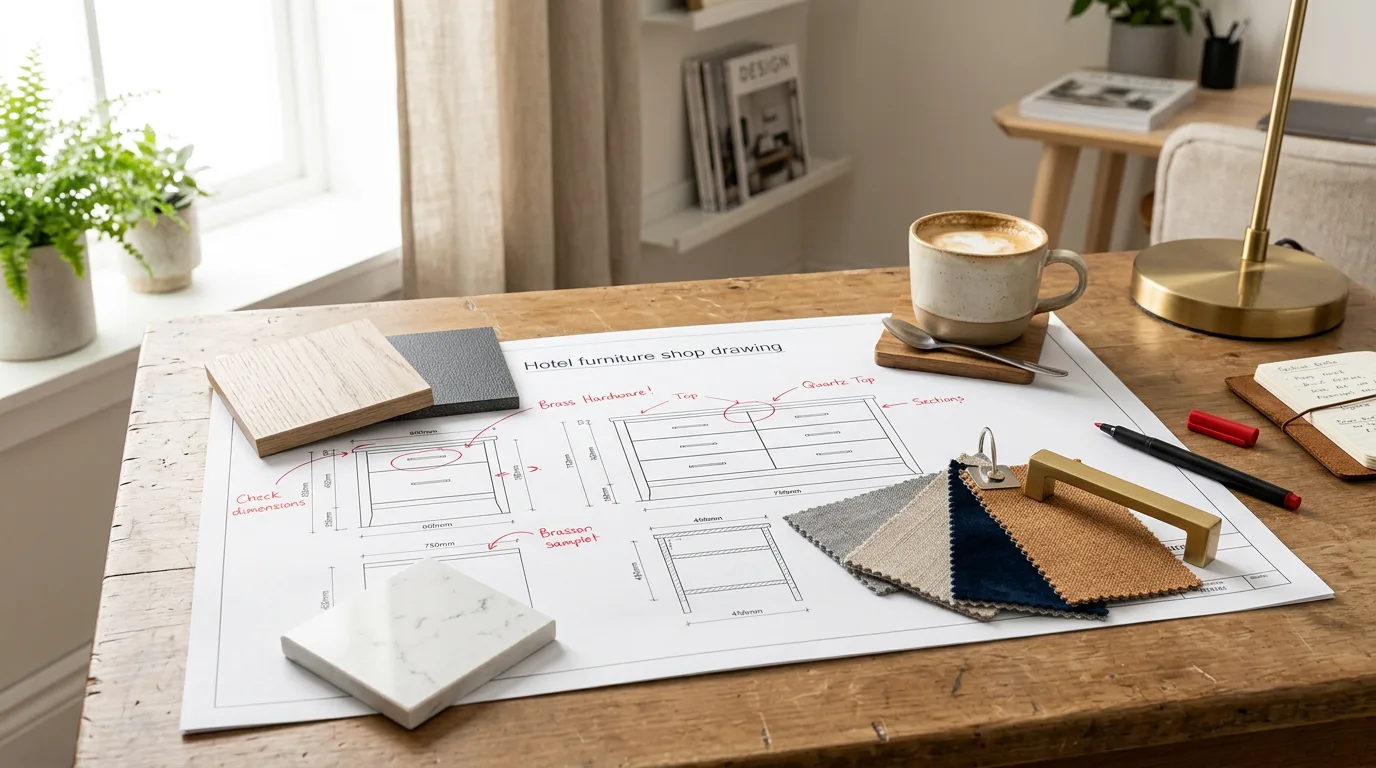
There's a finish sample on a desk this morning, under a coffee cup, waiting for a signature nobody has flagged as urgent. It's about to become the most important object in your spring renovation.
Lunar New Year 2027 falls on February 6, according to the Hong Kong government's 2027 holiday list. That's 11 days earlier than in 2026, so last year's timing habits will run late. If your case goods or soft furniture are made in a factory that observes the holiday, the Lunar New Year factory closure sets your spring schedule, whichever supplier you use.
Most owners hear a supplier's "order by" date as a sales deadline. It's really a production deadline, and production can't start until the drawings are signed. Getting them reviewed takes weeks, which is why the work starts in October, not November.
Here's how to work backwards from your install date, what "confirmed" actually requires, and what to split off so it isn't waiting on anyone's holiday.
What the Lunar New Year factory closure actually does to lead times
Lunar New Year, often called Chinese New Year, is an official holiday of about a week. The disruption around it is much longer, and freight forwarders describe the same pattern every year.
Before the holiday, factories slow output as workers prepare to travel home. Maersk puts the slowdown at two to three weeks. SEKO Logistics expects three to four weeks for 2027, which puts it in mid-January.
After the holiday, the restart is slow. SEKO says factories may reopen with about 35% of their workforce, and that by some estimates up to a quarter of workers don't return to their previous employer. It puts full recovery at four to six weeks after the holiday begins. Maersk says full capacity may not return until mid-March.
The holiday lasts about a week. By forwarders' estimates, the slowdown around it lasts closer to two months.
Freight tightens too, though less than the headlines suggest. In the first week of January 2026, Freightos reported Asia–US West Coast rates up 22% in a single week on pre-holiday demand. By late February, trade press reported rates largely flat after the holiday, and Drewry expected rising capacity to keep them under pressure.
What the holiday changed was the schedule. Carriers cut sailings to match the lull. Drewry counted 136 cancelled ("blank") sailings in February 2026 across the transpacific, Asia–Europe and transatlantic trades, most of them on the transpacific. That was 122% more than in January. A blank sailing is a voyage the carrier cancels, so a container that misses its ship waits for the next one.
With Sea-Intelligence projecting close to 10% overcapacity in 2027, the risk this year is less about price and more about your goods missing a boat. For how freight quietly adds up on an FF&E order, see the hidden logistics costs in your budget.
What "confirmed" really means, and which part slips
For a lot of imported goods, a purchase order starts production. Hotel FF&E doesn't work that way. Before a factory cuts a single panel, three things have to be true:
- 1. The order is placed.
- 2. The deposit is paid.
- 3. The shop drawings and finishes are approved. Shop drawings are the manufacturer's detailed drawings of exactly what will be built. Finishes are the physical samples: laminate, stain, fabric, hardware.
The first two take days. The third takes weeks.
The drawings need sign-off from the designer, the owner and, on a PIP (the brand's renovation to-do list), and usually the brand. Approval commonly runs to two or three rounds of comments, each taking a week or two or more. Nobody is being slow. Three busy parties are passing a PDF around between site walks.
The mistake to avoid: counting the lead time from the day you say yes. If a supplier quotes 12–14 weeks, the clock starts when the last approval lands, not at the verbal go-ahead and not when the PO is signed. Five weeks of back-and-forth on drawings is five weeks your install date just moved.
Work backwards from your install date
Start with the day the GC wants product on site, and walk back. This is the sequence for an overseas-made order that has to beat the holiday.
| Phase | When | What has to be true |
|---|---|---|
| Install | Week 0: the GC's window | Crew booked, floors or rooms ready |
| Delivery to site | The last few weeks of the quoted lead time | Ocean freight commonly 20–35 days port to port, plus 1–2 weeks inland. Ask your supplier whether their lead time includes it |
| Production | Starts at full confirmation | For a spring installation, most of the production should be completed by mid-January |
| Full confirmation | By November 15 | Order placed, deposit paid, drawings and finishes approved |
| Drawings and finishes in review | 3–6 weeks before confirmation: early to mid October | Two or three rounds between designer, brand and owner |
| Selections locked | Before drawings are issued: now | Brand spec, finish schedule, quantities by room type, deposit budgeted |
Source: slowdown timing from Maersk (2025) and SEKO Logistics (2026); approval rounds are common industry experience; freight transit is Nerval's published range. Your supplier's figures may differ.
Read it bottom to top and the point makes itself. November 15 is the finish line for decisions, and the decisions start in October.
Worked example: a 100-key PIP, on time vs three weeks late
Take a typical 100-key select-service hotel with a brand PIP due in spring 2027. This is an illustrative example, not a real project. The guestroom case goods and soft furniture come from an overseas factory, quoted at 12–14 weeks from full confirmation.
| Confirmed by November 15 | Confirmed about 3 weeks later (early December) | |
|---|---|---|
| Quoted lead time | 12–14 weeks | 12–14 weeks |
| Where production falls | Mostly before the mid-January wind-down | Runs into the wind-down, the closure and the restart |
| Holiday disruption to add | Little on production; goods are finishing or at sea around the holiday | About 3–6 weeks: our rough reading of the forwarder ranges above |
| Arrives, counted from November 15 | Weeks 12–14 | Weeks 18–23 |
Source: illustrative arithmetic. 3 weeks late + 12–14 weeks = weeks 15–17 on paper; + 3–6 weeks of disruption = weeks 18–23. Disruption ranges from Maersk and SEKO are industry-wide, not any one factory's. Your account executive will confirm the real numbers for your project.
Three weeks late on the approvals becomes six to nine weeks late on site. For a PIP with a spring deadline, that can be the gap between finishing before the summer season and asking the brand for an extension. At least one US hospitality procurement firm advises owners to carry four to ten weeks of contingency for anything affected by the holiday. Next to that, the 3–6 weeks here is on the optimistic side.
Split the order: not everything waits for the holiday
A PIP order is rarely one thing. Anything already in stock, or made domestically, isn't waiting on a factory that observes the holiday to reopen.
So ask each supplier which lines on your order are affected, and give the rest their own schedule. Mirrors, artwork or blinds that land on time let the GC keep moving room by room, instead of holding everything for the last container.

To be confirmed by November 15, you need…
- check_circle Owner: the signed order, the deposit released (check the timing against your lender's draw schedule if the work is financed), and final sign-off on drawings and finishes.
- check_circle Brand: approval of drawings and finishes against the PIP or brand standard, where the brand reviews FF&E.
- check_circle Designer: finish samples, fabrics and dimensions checked against the design intent, with everyone's markups merged into one set.
- check_circle GC: field measurements confirmed for anything built to fit, and the install window and sequence agreed.
- check_circle Purchasing: final quantities by room type, attic stock, delivery address and phasing, with in-stock and domestic lines split out.
- check_circle Ask your supplier: "Does your lead time start at the PO, at the deposit, or at final approval?"
For the wider procurement sequence this sits inside, see our practical guide to hotel FF&E planning and procurement.
Where Nerval fits
Here's how this works on our side. Our global production facility closes for the Lunar New Year holiday, and we're asking clients to confirm orders by November 15 to avoid delays. Confirmed means all three: order placed, deposit paid, and shop drawings and finishes approved, so production can start.
That lines up with our five-step process: Consultation → Deposit → Kickoff → Production → Delivery. Kickoff is the shop drawing review. "Confirmed" means the first three steps are done. If you're in Consultation now, the deposit and Kickoff are the two steps to get on the calendar this month.
Once an order is confirmed, our overseas lines, case goods and soft furniture, run 12–14 weeks to delivery. Your account executive will confirm for your project. Freight is quoted all-in, ocean and inland, so you're looking at one number.
Two things aren't affected by the closure:
- In-stock inventory. We carry $15M+ CAD in stock, ready to ship from our Canadian warehouse.
- What we make in Sherwood Park, Alberta: mirrors, artwork, window blinds and NervalWall glass partitions.
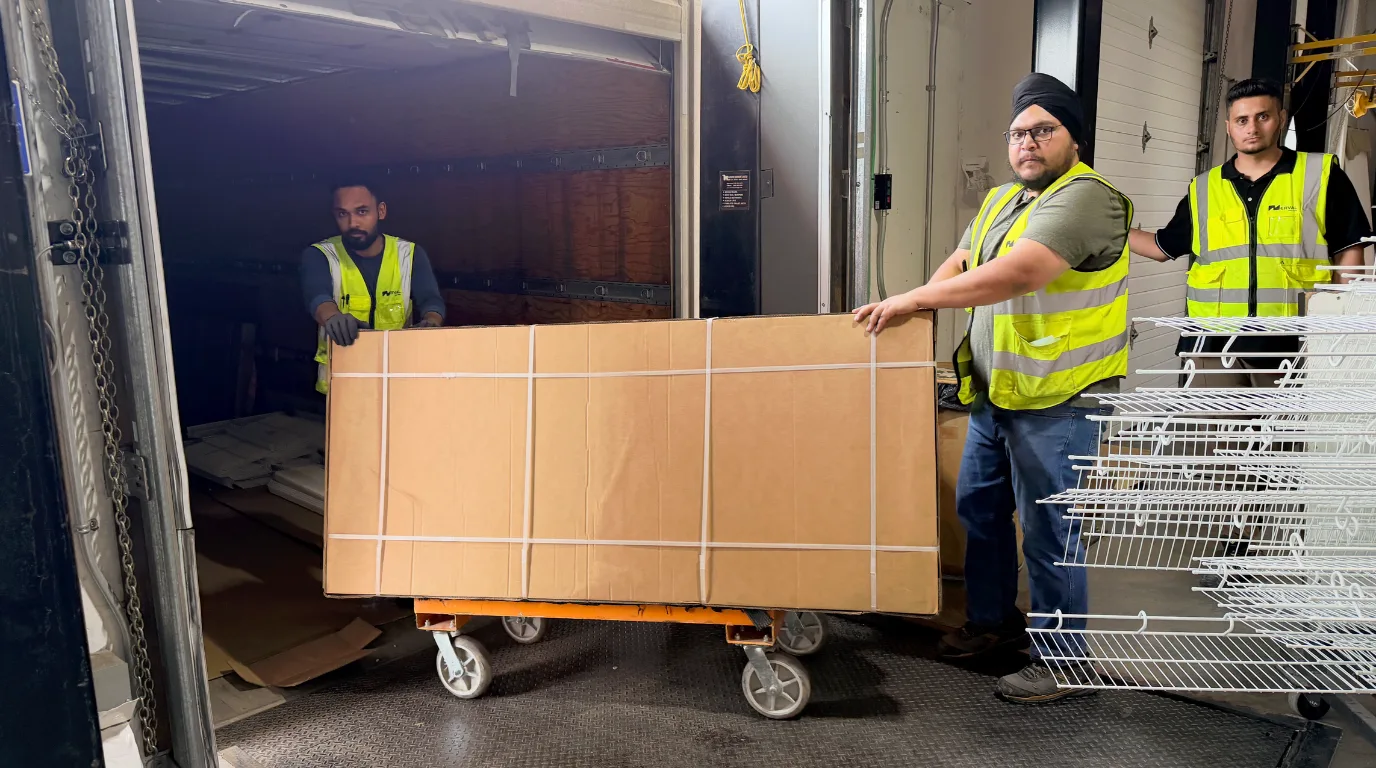
That makes splitting the order easy. Every project has a named account executive, not a call centre, so one person can tell you which lines have to beat November 15 and which can follow the GC's schedule.