

 Case Goods
 Soft Furniture
 Seating
 Bed Bases
 Shower Solutions
 Mirrors
 Lighting
 Artwork
 Window Coverings
 Hotel Essentials
 Micro Markets
 Wall Systems
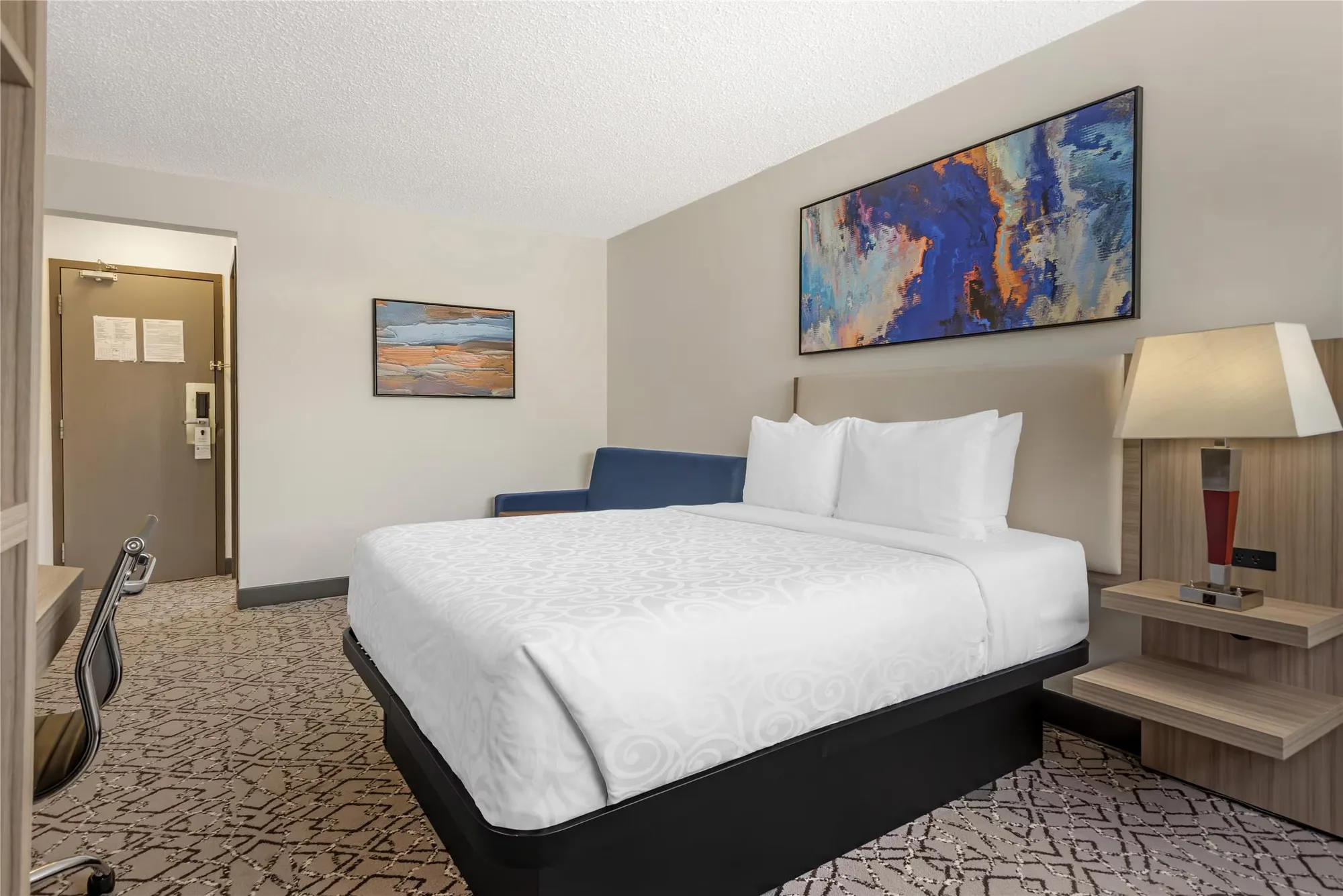
The next time your mattresses are replaced, look at what's going out on the truck. If you follow the mattress industry's own advice, there's a box spring under every one of them: bought at opening, hauled away now, and about to be bought again.
That's the hotel version of the platform bed vs box spring question. A box spring is a purchase you repeat. A platform bed base (frame and mattress support in one piece) is a purchase you make once. The switch isn't free of trade-offs, though. Three of them (the mattress warranty, the bed height and accessible rooms) can cost more than the base if you miss them.
This guide covers what changes for housekeeping, pest control and freight, where the switch goes wrong, and a checklist for specifying a platform base.
Why the box spring keeps coming back on the PO
A box spring is the fabric-covered wooden box that sits on a metal frame under the mattress. (A "foundation" is the same box with a rigid grid instead of springs.) The mattress industry sells and retires the two as a pair. The Better Sleep Council, which is sponsored by the mattress industry's trade association, puts it this way: "in general a mattress set that is seven years old has reached the end of the line."
Two caveats. That's consumer guidance from 2017, and hotels replace mattresses on their own schedule, driven by condition and the PIP (the brand's renovation to-do list). But the logic holds. If the set wears out together, the box spring leaves with the mattress, and a new one arrives with the next.
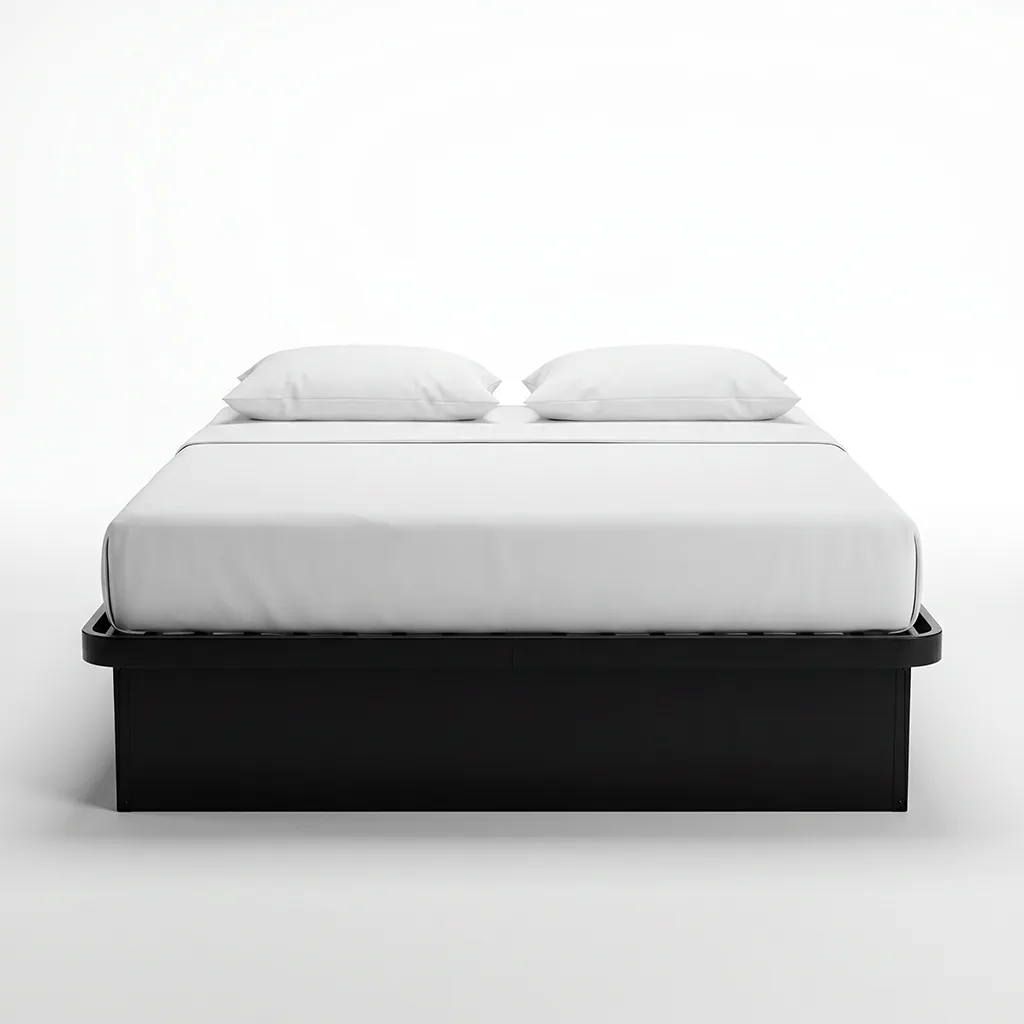
A platform base takes that second purchase off the schedule. It's one steel unit, assembled once, and it doesn't need replacing when the mattress does. At the next replacement you buy mattresses. Only mattresses.
A box spring is a purchase you repeat. A platform base is a purchase you make once.
Under the bed: housekeeping, lost items and bed bugs
An open frame has an under-bed. An enclosed base doesn't. That sounds minor until you count what collects down there: dust, a phone charger, one sock, and now and then the TV remote the front desk has been hunting since spring. An enclosed base blocks that space, so there's nothing to clean under and nothing to lose. We found no study of housekeeping minutes saved, so we won't invent one. The benefit is simply one less place to reach.
Bed bugs are the more serious point, so here's what the sources actually say. The University of Kentucky's entomology extension says box springs "afford many places for bed bugs to hide, especially along the upper seams and underneath," and the dust cover may have to come off to inspect and treat them. If you can afford only one encasement, it says it's often best to encase the box spring, which is "harder to subsequently inspect." The EPA and the CDC both list box springs among the usual hiding places. Kentucky also notes that bed bugs "have an affinity for wood and fabric more so than metal or plastic."
So a steel platform takes a fabric-and-wood box out of the bed, and leaves housekeepers and pest-control technicians fewer seams to check. That's the claim, and it stops there. It doesn't prevent bed bugs. The same Kentucky guide says that in hotels, "the area behind the headboard is often the first place bed bugs become established," and no base changes that. The CDC adds that how clean a place is doesn't determine whether bed bugs are present. A base is one part of a pest-management plan. It isn't the plan.
Platform bed vs box spring: four things to check before you switch
None of these is a reason not to switch. All of them are reasons to check before the purchase order.
1. The mattress warranty
Mattress makers set the support their warranties require, and they don't agree. Tempur Sealy's published terms for Sealy and Stearns & Foster platform frames call for slats at least 3 inches wide and no more than 4 inches apart, with centre support. Tempur-Pedic's warranty sets the same limits and says the wrong foundation voids it. Serta recommends slats no more than 2 inches apart. A base that suits one mattress can fall outside another's terms.
Those are published consumer terms. We couldn't find hospitality mattress contract terms published anywhere. So get your mattress supplier's support requirement in writing. Then get the base supplier's slat width, slat gap and centre-support detail in writing, and compare the two before anyone signs.
2. Bed height
A box spring on a frame sets the height guests are used to. A platform base sets it alone, and the sum is simple: base height plus mattress depth is the sleeping height.
The 2010 ADA Standards don't set a bed height. Section 806.2.3 requires clear floor space beside the bed (30 by 48 inches, positioned for a wheelchair user to pull up alongside). The question isn't closed, though. In 2021 the US Justice Department argued, in Migyanko v. Aimbridge Hospitality, that where the Standards don't address bed height, the ADA's general duties still apply. The ADA National Network recommends 20 to 23 inches from the floor to the top of the mattress. That's guidance, not a rule.
So do the arithmetic with your mattress, not a catalogue's.
| Base height | Mattress depth | Sleeping height | Inside the 20–23" guidance? |
|---|---|---|---|
| 10" | 10" | 20" | Yes |
| 10" | 13" | 23" | Yes |
| 10" | 14" | 24" | No |
| 16" | 12" | 28" | No |
Source: arithmetic, illustrative mattress depths. The 20–23" range is a recommendation from the ADA National Network's Accessible Lodging fact sheet (2017), not a requirement of the 2010 ADA Standards.
Notice the third row. Same base, a mattress one inch deeper at the next replacement, and your accessible rooms have moved.
3. Accessible rooms in California
California goes further. Under California Building Code section 11B-806.2.3.1, accessible guestrooms need clear space under the bed for a personal lift device, the portable hoist whose legs slide under the bed. The space runs 30 inches in and 7 inches high along the long side, next to an accessible route. That wording appears in the 2016 and 2019 editions. The 2025 code, in force since January 2026, amended the section, so confirm the current text with your accessibility consultant.
A fully enclosed base has no space under it. That's the point of it. In those rooms, an open-leg frame with the right clearance belongs there instead.
A federal letter points the same way. In 2000 the DOJ wrote that it "has never provided guidance on whether hotels are required to have open-frame beds." But for guests who travel with portable lifts, it added, "it appears that it would be a reasonable modification" to provide them. It's dated, but it's still the only federal statement on the question we found.
4. Feel and noise
A box spring has a little give. A slatted steel deck doesn't, so a mattress designed to sit on a foundation can feel firmer on a platform. Steel panels can also tick if a connector works loose, which a routine housekeeping check catches. Before you order for the whole property, put one sample bed in a room and have a few staff sleep on it.
Worked example: 180 beds, two ways
Take an illustrative 120-key select-service: 60 king rooms and 60 double-queens, so 180 beds (60 kings, 120 queens).
With box springs, a queen is a frame plus a box spring: 2 pieces. Most king box springs come as two half-width pieces (a split foundation, easier to get up a stairwell), so a king is 3 pieces. A platform route is one base per bed. A flat-packed base can ship as several panels in one carton, so we're counting bases, not cartons.
| Measure | Frame + box spring | Platform base |
|---|---|---|
| Pieces to receive, carry and set at opening | 420 (60 × 3 + 120 × 2) | 180 bases |
| Box springs in the building | 240 (120 queen + 120 king halves) | 0 |
| Bought at the first mattress replacement | 180 mattresses + 240 box springs | 180 mattresses |
| Hauled away at that replacement | 180 mattresses + 240 box springs | 180 mattresses |
| Box springs bought over opening + two replacements | 720 | 0 |
Source: illustrative composite, not a Nerval project. Assumes box springs are replaced with the mattresses, as mattress-industry consumer guidance suggests (Better Sleep Council, 2017), and that the bed frames (box-spring route) and platform bases are kept through each mattress replacement. Split king foundations are common industry practice, not a sourced share.
Per room, it isn't dramatic. Across a building it is: 240 box springs to ship, stage and carry up, then carry back down and dispose of a few years later, then do it again. Freight has a way of hiding in exactly this kind of volume; we've written about what's hidden in an FF&E logistics quote.
Checklist: how to specify a hotel platform bed base
- check_circle Weight capacity: What's the rated load, and how was it tested?
- check_circle Construction: Steel gauge, welded or bolted joints, finish.
- check_circle Slat width, slat gap and centre support: In writing, and checked against your mattress maker's written requirement.
- check_circle Enclosed or open: Which rooms need open space under the bed?
- check_circle Height profiles: What is the profile height measured to? Add your mattress depth and write down the sleeping height for every room type.
- check_circle Accessible rooms: Confirm the bed with your accessibility consultant and your brand, including California's lift clearance if it applies.
- check_circle Assembly: Are tools needed? How many cartons per base? How long per room?
- check_circle Floor contact: What touches the floor, and will it mark your flooring?
- check_circle Warranty: How long, and what's covered?
- check_circle Availability: Which sizes are stocked? Can you get matching attic stock (spares for future damage) later?
- check_circle Brand standard: Check the current standard for anything it says about bed bases.
Where Nerval fits
We supply platform bases, so read this section knowing that.
Our Platform Bed Base is a fully enclosed 19-gauge steel platform with rectangular steel slats and welded corners, rated to 3,000 lb, with no box spring needed. Panels lock together without tools, and it ships flat. The enclosed side panels keep the under-bed space clean and discourage pests (keep inspecting behind the headboard anyway). It carries a limited lifetime warranty.
It comes in a Standard 16-inch profile and an ADA 10-inch profile. "ADA 10-inch" is the name of the lower profile; as above, base plus mattress is the height that counts. King and Queen are in our Stock Program in both profiles, and Double XL in the 16-inch. Custom sizes are available for large projects.
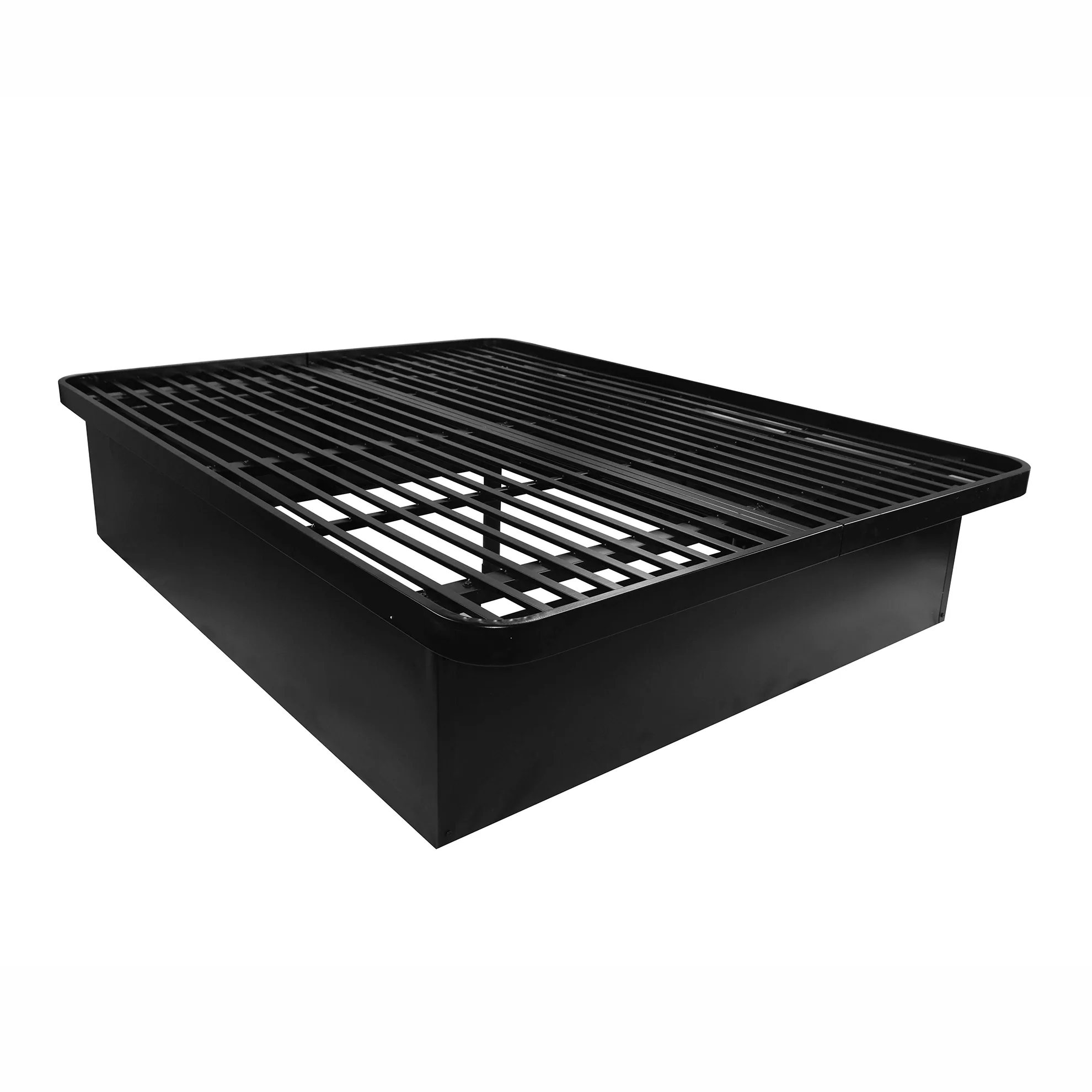
For rooms that need a portable lift's clearance under the bed: none of our stock bases is designed to leave that space. Specify an open-leg frame for those rooms and confirm the clearance with your accessibility consultant. The rest of our range, including a steel Metal Bed Base and a woodgrain option, is on our hotel bed bases page.
Every project gets a named account executive. Send them your room mix and your mattress maker's support requirement, and they'll work through the checklist above with you. Freight is quoted all-in, and we keep $15M+ CAD of inventory in stock, bed bases included.